Considering a career in Human Resources (HR) and wondering where it could lead?
The answer: In countless dynamic and rewarding directions.
The sheer volume of human resources job titles and functions speaks to the rich professional diversity and potential within the field of HR but can be overwhelming to those just starting out (and even sometimes to seasoned HR veterans). From Learning and Development to Recruitment, Compensation and Benefits, and Diversity, Equity, and Inclusion, there is a vast array of potential specialties and professional opportunities to discover and navigate as an HR professional. Of course, there’s also plenty of room to grow vertically and advance into high-level leadership roles as you gain HR experience.
But how do you progress from an entry-level role like HR Assistant to a top-level executive position like Chief HR Officer (CHRO)? And what if you’re interested in exploring multiple HR functions or areas of specialization along the way?
Below, we’ve provided an in-depth overview of the HR career path (spoiler alert: It’s not just a single linear path) and explored some essential HR skills as well as the job market outlook for HR professionals. To learn more about kickstarting your HR career with our Business Administration HR program at Robertson College, contact one of our knowledgeable and supportive Student Advisors today!
Quick Summary: What You’ll Learn In This Guide
If you are passionate about organizational development and working with people but aren’t certain what a career path in human resources might look like, then this post is for you. In it, we’ve explored the modern HR career path, broken down some of the essential skills necessary for HR professionals, discussed various generalist and specialist HR roles, provided a clear overview of how to get started in HR, and much more.
Click below to jump directly to a specific topic:
- Why Choose A Career In HR?
- The Modern Career Path For HR
- Essential Skills For A Successful HR Career
- HR Career Progression: Levels And Roles
- Generalist HR Career Path
- Specialist HR Career Paths
- Educational Requirements And Certifications For HR Careers
- HR Career Opportunities And Job Market Outlook
- How To Get Started In HR: A Step-By-Step Guide
Why Choose A Career In HR?
People are the core of any organization. From recruiting and hiring to training, compensation, and the establishment of a safe, inclusive company culture, human resources professionals support this core in myriad different ways. If you’re seeking an engaging career that will allow you to contribute to shaping the culture, development, and success of an organization while also having a direct and meaningful impact on the lives and professional experiences of its employees, then HR may be the perfect fit.
Three of the top reasons to choose a career in HR include:
- People-Focused – Work directly with people, build relationships, and foster a supportive, positive work environment.
- Diverse Career Options – Build a diverse professional skill set as an HR generalist or move into more specialized functions and roles along the way.
- Influence Organizational Development – Play a key role in designing and implementing HR initiatives that contribute to the overall growth and success of an organization.
The Modern Career Path For HR
Traditionally, the HR career path was viewed as a linear series of steps leading from an entry-level role up to the highest leadership level possible over time. While upward progression through the hierarchical structure of an organization (or more than one organization) is still a goal for many HR professionals, the modern HR career path is often much less linear and can involve a much greater breadth of experiences across different specialties.
It isn’t uncommon to move into HR with professional experience in another field (such as marketing, sales, or business administration) or to move out of HR and into another career path having gained relevant/transferable experience and skills. In today’s less predictable business environment, where flexibility and diverse work experience are highly valued, moving laterally as well as vertically and exploring multiple HR roles and specialties throughout your career is accepted and expected. Rather than detracting from your resumé, diverse professional experiences in HR (and beyond) can actually be vital to career advancement.
So what’s the takeaway? Pursue the HR positions that resonate with your interests and talents and don’t worry if they don’t fall into a perfect line. The modern HR career path can have many twists and turns, yet still allow you to attain top-level leadership roles within an organization (if, indeed, that’s your ultimate goal).
Essential Skills For A Successful HR Career
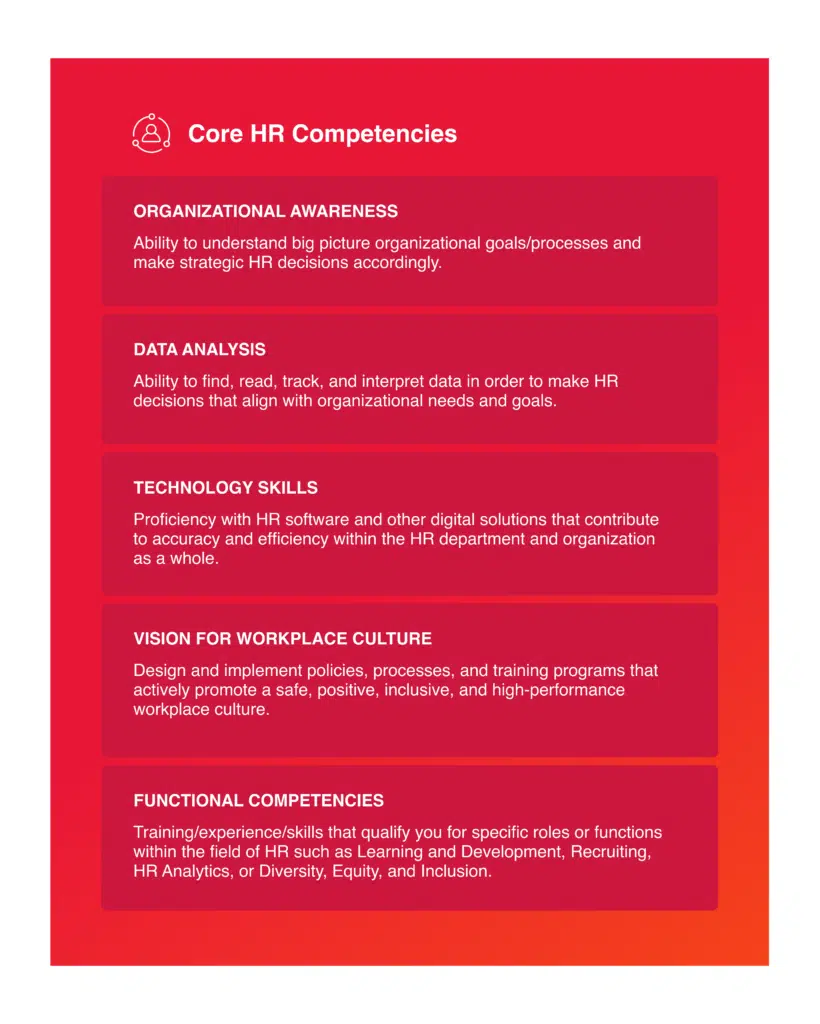
Countless professional competencies can be associated with a successful career in human resources. These may range from general skills like effective communication, attention to detail, and the ability to multi-task to more technical skills like proficiency with specific software/systems, knowledge of training development principles, and HR data analysis.
In the chart above, we’ve highlighted four critical HR competencies that underpin a successful career in human resources across all functions and areas of specialization. In addition to these core competencies, individuals considering a career in HR must also develop functional competencies related to the specific role, position, or specialty they hope to pursue.
HR Career Progression: Levels And Roles
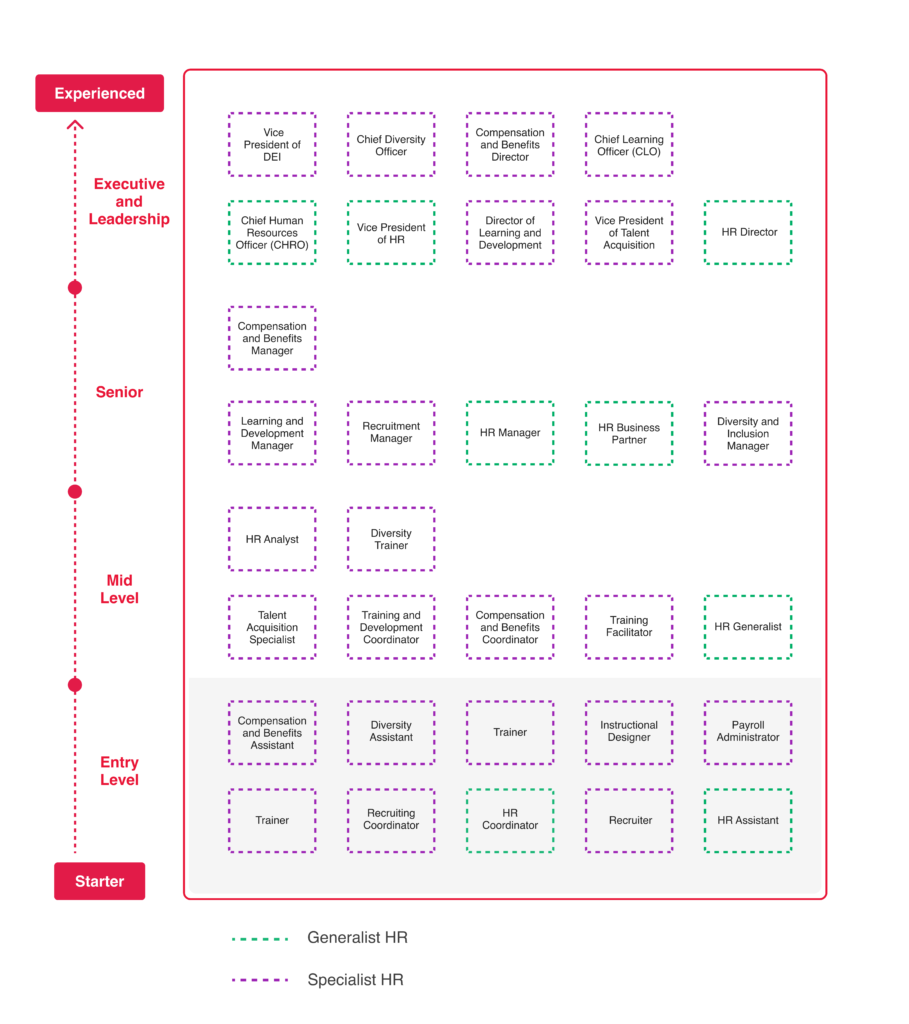
The graphic above shows a selection of common HR roles/position titles and where they typically fit within the hierarchy of an organization (though, of course, this can vary significantly depending on the size and structure of the organization). Envision yourself being hired in an entry-level position and then advancing into the roles that interest and inspire you the most. What would your career path look like? A straight line? A zig-zagging staircase? A meandering journey?
Take some time to imagine your ideal HR career path. Below, we’ve provided some in-depth information on generalist roles and common HR specialties to help you along the way:
Generalist HR Career Path
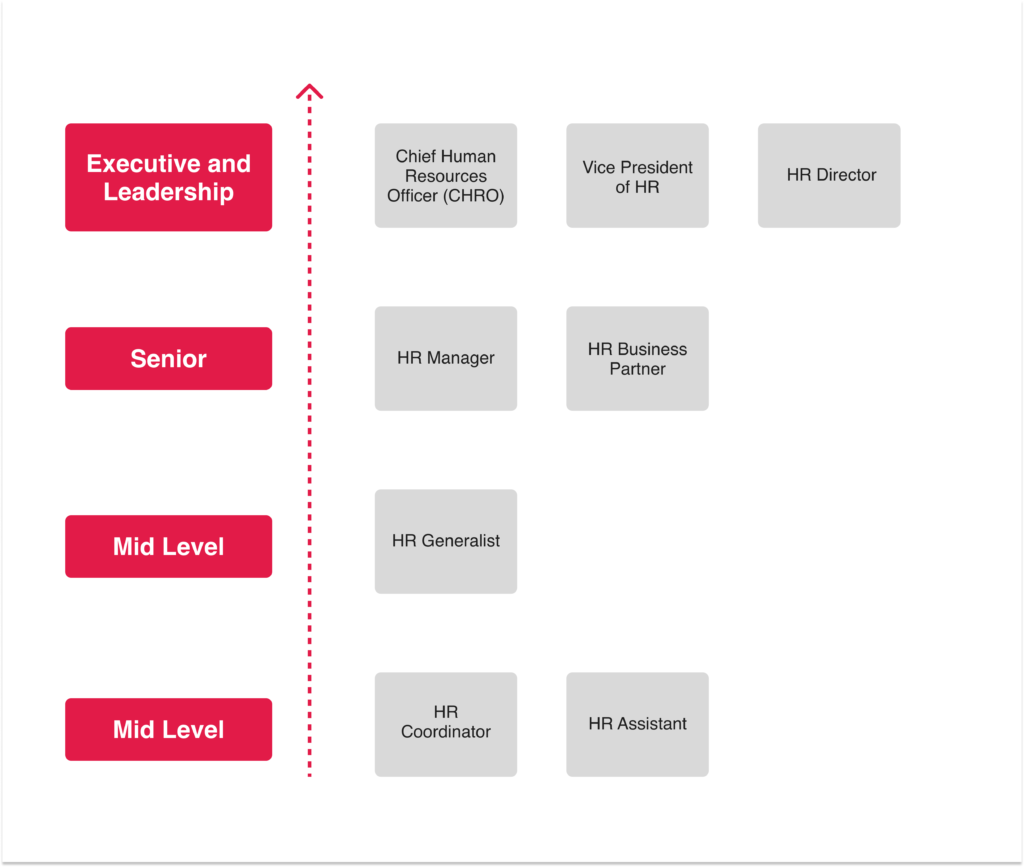
As you might guess, a generalist HR career path encompasses a broad range of HR functions and disciplines including onboarding, training, team member relations, retention, and much more. While some HR professionals pursue generalist roles throughout their entire careers, others enter the field of human resources in a generalist role in order to gain foundational experience before transitioning into a more specialized niche.
The exact duties and responsibilities of an HR generalist depend on the size of the organization and the way its HR department is structured. Small businesses may have just a single HR generalist to fulfill all of their HR needs, while major corporations often have a team of HR generalists who are responsible for performing core HR tasks while also supporting specialist team members in their areas of expertise. Ultimately, the generalist HR career path can lead to top-level leadership positions such as director of human resources or chief human resources officer (CHRO).
In the world of HR, there is no prescribed right or wrong when it comes to choosing a generalist or specialist career path. As in any field, HR generalists have more diversity in their skillset and workload than specialists, but less expertise in specific areas. If you enjoy the idea of being a jack-of-all-trades, constantly keeping your finger on the pulse of a wide range of projects and initiatives, and having plenty of variety in your workdays, pursuing a generalist HR career path could be the right fit. (Plus, you could always change your mind along the way. Switching from a general role to a more specialized HR role is common, particularly within the first few years of your career.)
Benefits Of A General HR Career Path
Pursuing a general HR career path can have many benefits, including the following:
- Professional Variety – HR generalists have the chance to work on a diverse array of HR projects and initiatives. No two days are identical and there’s the opportunity to gain a spectrum of skills through a broad HR lens.
- Small Business—Big Impact – In a small business setting, an experienced HR generalist’s breadth of knowledge can be a huge advantage. If you’re interested in making a big impact on a smaller organization, you may want to consider pursuing a generalist HR career path.
- Foundation for Specialization – The broad skills and experience gained as an HR generalist can help you identify your interests/strengths and be the jumping-off point for a more specialized HR career.
While no two HR career paths are identical, the standard generalist HR career path moves from a general entry-level role such as HR Assistant to a senior leadership role such as Vice President of HR, HR Director, or Chief Human Resources Officer (CHRO). Listed below are some common general HR positions categorized by experience level:
Entry-Level Generalist HR Roles (0-3 Years Of Experience)
HR Assistant
This entry-level role involves performing administrative duties and assisting with a wide variety of human resources tasks and projects within an organization. Many HR professionals begin their career journeys as HR Assistants. If you are looking to enter the field and gain valuable experience, this type of position could be an excellent fit.
KEY RESPONSIBILITIES
- Administrative duties
- Records maintenance
- Data management
- Document and report preparation
- Schedule management
- HR project support
ESSENTIAL SKILLS
- Excellent communication
- Attention to detail
- Organization and time management
- Proficiency with HR software
BENEFITS OF THE ROLE
- Build foundational HR skills
- Gain exposure to a wide variety of HR roles, projects, and career paths
- Contribute to positive employee experiences and company culture
POTENTIAL NEXT STEPS
After gaining experience as an HR Assistant, many HR professionals move on to become an HR Coordinator or take on another generalist position in HR administration. Moving into a more specialized HR role is also a possibility.
HR Coordinator
An HR Coordinator acts as a link between employees and the HR management team. A fundamental element of the role is working with various departments to explain and implement HR policies and procedures. HR Coordinators help improve organizational efficiency while also supporting the daily operations of the HR department.
KEY RESPONSIBILITIES
- Coordinate recruitment and onboarding processes
- Manage and track employee attendance/leaves
- Provide conflict resolution support
- Manage employee development initiatives
- Support various HR programs and projects
ESSENTIAL SKILLS
- Excellent communication and interpersonal skills
- Attention to detail
- Proficiency with HR software
- Conflict resolution skills
- Knowledge of employment laws and best practices
BENEFITS OF THE ROLE
- Gain valuable experience across a variety of different HR functions
- Build meaningful relationships with teams and improve interdepartmental communications
- Help improve organizational efficiency and contribute to workplace culture
- Develop vital professional skills in areas such as project management, conflict resolution, and training and development
POTENTIAL NEXT STEPS
With experience as an HR Coordinator, many HR professionals are able to advance into higher-level generalist HR roles or move into a more specialized HR niche, such as Training and Development, Recruitment, or Compensation and Benefits.
Mid-Level General HR Roles (3-7 Years Of Experience)
HR Generalist
The role of an HR generalist encompasses a broad range of HR duties and skills including recruitment and hiring, employee relations, benefits administration, training and development, performance management, and more. The scope of work and leadership responsibilities associated with this type of position may vary depending on the size and structure of the business or organization.
KEY RESPONSIBILITIES
- Provide comprehensive support to the HR management team and various departments
- Organize and oversee recruitment and onboarding processes
- Conduct performance reviews
- Guide conflict resolution
- Ensure compliance with labour laws and best practices
- Support various HR projects and initiatives
ESSENTIAL SKILLS
- Experience in a variety of HR functions
- Excellent interpersonal, communication, and conflict-resolution skills
- A high level of proficiency with HR software
- The ability to think critically and problem-solve
BENEFITS OF THE ROLE
- Gain in-depth experience in a wide range of HR functions
- Positively impact employee engagement and company culture
- Build meaningful relationships with teams and across departments
- Have the opportunity to work on multiple projects simultaneously
POTENTIAL NEXT STEPS
Many HR generalists advance to take on a role in HR management or even join the executive team. Moving into a more specialized HR niche after holding this type of position is also an option.
Senior General HR Roles (7+ Years Of Experience)
HR Manager
An HR Manager oversees daily HR operations for an organization and leads HR team members, ensuring quality project outcomes that are in alignment with company goals. This role requires a high level of experience and expertise across all HR functions.
KEY RESPONSIBILITIES
- Oversee daily HR operations
- Develop and implement HR strategies and initiatives
- Provide learning and development opportunities for the HR team as well as other teams
- Manage conflict resolution initiatives
- Establish a positive company culture
ESSENTIAL SKILLS
- Leadership/management experience
- Ability to think strategically
- Excellent interpersonal and communication skills
- Expertise across various HR functions
- Deep understanding of organizational goals and workplace culture
BENEFITS OF THE ROLE
- Hone advanced HR and strategic planning skills
- Have the opportunity to mentor more junior HR professionals and positively impact company culture
- Contribute to organizational development and success
POTENTIAL NEXT STEPS
Many HR Managers advance into executive roles in HR such as HR Director, Chief Human Resources Officer (CHRO), or Vice President of HR. Moving into a leadership role in an HR specialty such as Learning and Development or HR Operations or Analytics could also be an option.
HR Business Partner
HR Business Partner is an advisory role that bridges communication between business management and the core HR team. An individual in this position provides strategic advice that helps align HR strategies with overall organizational goals and objectives.
KEY RESPONSIBILITIES
- Provide expert, strategic advice to drive HR procedures and policies within an organization
- Support other leadership teams in understanding HR initiatives and best practices
- Drive and support change initiatives
- Use data analysis to inform HR strategies that align with company goals and objectives
- Act as a consultant for team development programs and employee retention strategies
ESSENTIAL SKILLS
- Proven expertise in HR best practices across all HR functions
- Analytical thinking, strategic reasoning, and problem-solving skills
- Strong presentation skills
- In-depth knowledge of the organization and its goals
- Ability to lead and inspire
BENEFITS OR THE ROLE
- Gain a big-picture understanding of organizational goals and directions
- Gain valuable business knowledge
- Drive change through strategic company-wide initiatives
- Build relationships between various leadership teams and streamline organizational efficiency
POTENTIAL NEXT STEPS
After holding the position of HR Business Partner, it is common to move into a senior HR leadership position such as HR Director, Chief Human Resources Officer (CHRO), or Vice President of HR.
Executive And Leadership General Roles In HR
HR Director
An HR Director is responsible for developing and leading an organization’s HR strategy. This includes overseeing and managing all HR functions, ensuring compliance with employment laws and best practices, implementing initiatives to improve company culture, and aligning HR activities with overall company goals.
KEY RESPONSIBILITIES
- Develop and lead HR projects and initiatives that align with company objectives
- Provide mentorship to senior HR professionals, such as HR Managers and HR Business Partners
- Manage HR budgeting and resources
- Spearhead recruitment for high-level executive roles
- Mediate escalated workplace disputes
- Establish a positive company culture
ESSENTIAL SKILLS
- Exceptional communication and leadership skills
- Expert knowledge of best practices across all HR functions
- Proven ability to organize and oversee multiple projects and initiatives at the same time
- Strategic thinking, problem-solving, and decision-making skills
- Budgeting and resource management skills
BENEFITS OF THE ROLE
- Drive meaningful change within an organization
- Help to directly shape the culture and future of a company
- Gain experience working with executive team members
POTENTIAL NEXT STEPS
For generalist HR professionals who aim to move beyond a leadership role such as HR Director, the next steps could include becoming Chief Human Resources Officer (CHRO) or Vice President of HR.
Vice President Of HR
A Vice President of HR is a high-level HR executive responsible for driving HR initiatives that promote organizational growth and employee satisfaction.
KEY RESPONSIBILITIES
- Strategic planning and implementation of big-picture HR initiatives
- HR operations management
- Foster an engaged, high performance work environment
- Manage high-level HR budgeting, talent acquisition, leadership development, and decision-making
- Work with the executive leadership team to shape company-wide policies and programs
ESSENTIAL SKILLS
- Exceptional leadership and communication skills
- Proven in-depth knowledge of current best practices across all HR functions
- Extensive management experience
- Deep understanding of company goals and initiatives
- Strategic thinking
- Expertise in business knowledge
BENEFITS OF THE ROLE
- Drive meaningful change within an organization
- Mentor and support other HR professionals
- Gain executive leadership experience
POTENTIAL NEXT STEPS
Becoming a Chief Human Resources Officer (CHRO) is often the next step for a vice president of HR.
Chief Human Resources Officer (CHRO)
Chief Human Resources Officer (CHRO) is the highest-ranking HR position in an organization. An individual in this role uses HR strategies to drive big-picture change and continually improve organizational development and growth.
KEY RESPONSIBILITIES
- Develop and implement HR strategies that support an organization’s big-picture goals and objectives
- Communicate HR needs and updates to the executive management team
- Design and oversee company-wide employee learning and development programs
- Spearhead a positive, high-performance company culture
- Ensure legal compliance and best practices within all HR functions
- Drive diverse, equitable, and inclusive practices
ESSENTIAL SKILLS
- A high level of expertise in all areas of HR management
- Exceptional leadership and communication skills
- In-depth knowledge of big-picture company goals
- A strong vision for company culture
- Strategic planning skills
BENEFITS OF THE ROLE
- Improve company culture and employee engagement at the highest level
- Directly impact the success of an organization
- Collaborate with a variety of stakeholders to develop meaningful strategies and solutions
- Become an industry leader
POTENTIAL NEXT STEPS
After fulfilling the role of CHRO, some HR professionals move into other senior leadership positions such as Chief Operations Officer (COO) or Chief Executive Officer (CEO).
Specialist HR Career Paths
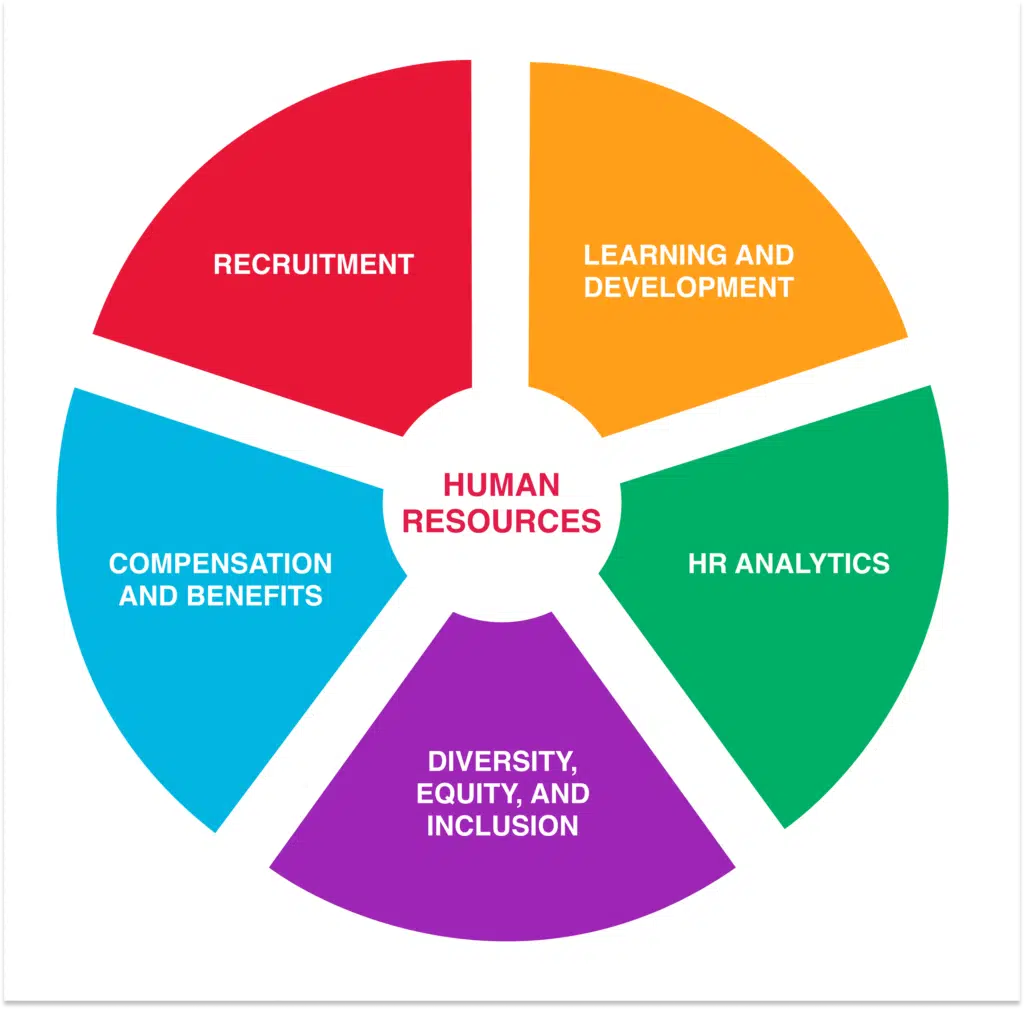
A specialist HR career path is rooted in one particular area or function within the field of human resources, such as Recruitment, Learning and Development, Compensation and Benefits, Diversity, Equity, and Inclusion, HR Analytics, Payroll, HR Operations, Organizational Development, or Employee/Industrial Relations. Many HR specialists begin their careers in one or more generalist roles before transitioning into a specialized niche.
HR specialists engage in HR work through a more focused lens than their generalist counterparts and have the opportunity to hone specialized skills and gain a high level of expertise in a specific area. Like a generalist HR career path, a specialist career path can lead to top-level leadership positions within an organization. If you’re interested in an HR career path that will allow you to deeply pursue a particular strength, passion, or area of interest, becoming an HR specialist may be the right fit.
Benefits Of A Specialized HR Career Path
Pursuing a specialist HR career path can have many benefits, including the following:
- Play to Your Strengths and Interests- Become a specialist in an area of HR that will allow you to build on your personal talents, strengths, and passions.
- Gain a Deep Level of Expertise – Dedicate yourself to gaining specialized knowledge and honing skills within one specific HR discipline, rather than acquiring general knowledge and skills across a broader spectrum of HR functions.
- In-Demand Skillset – With a specialized HR skillset, you’ll be qualified to apply for in-demand roles within your area of expertise.
Listed below are some common HR areas of specialization:
Recruitment
The HR specialty of Recruitment encompasses all aspects of the recruitment and hiring process. HR professionals who specialize in this function are tasked with the responsibility of finding and securing the right talent for positions in every department and at every level of an organization. Do you enjoy conducting interviews and directly helping shape personnel teams? If so, an HR career in Recruitment could be something to consider.
POSSIBLE JOB TITLES
Recruiter, Recruiting Coordinator, Talent Acquisition Specialist, Recruitment Manager, Vice President of Talent Acquisition
ROLES AND RESPONSIBILITIES
- Create/advertise job postings
- Screen resumés
- Conduct interviews
- Communicate with candidates throughout the hiring process
- Develop strategic recruitment strategies to attract top talent
ESSENTIAL SKILLS
- Excellent interpersonal and communication skills
- Proficiency with recruiting software
- Organization and attention to detail
- Strategic thinking
- Strong interview and candidate evaluation skills
WHERE CAN THIS CAREER PATH LEAD?
Individuals with extensive recruiting experience may be able to take on leadership roles such as Recruiting Manager/Director or even executive roles such as Vice President of Talent Acquisition or CHRO. Some experienced recruiters may also choose to become recruitment freelancers or high-level consultants.
Learning And Development
Learning and Development (L&D) HR specialists are responsible for assessing organizational training needs and then developing and delivering programs to support company growth and success. Individuals who enjoy developing educational curricula, facilitating professional development, and helping others grow in their roles may find themselves drawn to an HR career in Learning and Development.
POSSIBLE JOB TITLES
Trainer, Instructional Designer, Training Specialist, Training Facilitator, Training Coordinator, Learning and Development Manager, Director of Learning and Development, Chief Learning Officer (CLO)
ROLES AND RESPONSIBILITIES
- Assess organizational training needs
- Design and deliver training programs
- Evaluate the success of training programs
- Develop training strategies that align with organizational needs and goals
ESSENTIAL SKILLS
- Excellent interpersonal and communication skills
- Knowledge of instructional design principles
- Ability to plan strategically based on the needs and goals of the organization
- Creative thinking
- Strong presentation skills
- Collaboration and teamwork
WHERE CAN THIS CAREER PATH LEAD?
A career in Learning and Development can lead to the attainment of high-level positions such as Director of Training, Chief Learning Officer (CLO), or Chief HR Officer (CHRO). Some Learning and Development specialists may also choose to become consultants or coaches within their area of expertise.
Compensation And Benefits
Compensation and Benefits (Comp & Ben) is an HR specialty focused on the design and administration of employee benefits programs and compensation packages. Specialists in this field are responsible for creating compensation and benefits strategies that align with organizational objectives, developing and implementing compensation and benefit policies and procedures, and assisting employees in understanding their benefit and compensation options.
POSSIBLE JOB TITLES
Compensation and Benefits Specialist, Benefits Coordinator, Compensation Manager, Compensation and Benefits Analyst, Compensation and Benefits Director, Vice President of Benefits
ROLES AND RESPONSIBILITIES
- Research market trends to determine competitive compensation and benefits packages
- Develop and implement benefits and compensation strategies based on organizational needs and goals
- Develop organizational policies related to compensation and benefits
- Communicate benefits and compensation information to employees
ESSENTIAL SKILLS
- Familiarity with compensation design principles
- Knowledge of laws and regulations affecting compensation and benefits
- Excellent organizational and analytical skills
- Proficiency with compensation and benefits software
- Ability to communicate clearly and effectively
WHERE CAN THIS CAREER PATH LEAD?
A career path in Compensation and Benefits can lead to leadership roles such as Compensation and Benefits Director or Vice President of Compensation and Benefits. Individuals with a background in Compensation and Benefits may also be a good fit for generalist HR roles such as HR Director or Vice President of Human Resources.
Diversity, Equity, And Inclusion
Diversity, Equity, and Inclusion (DEI) specialists work closely with companies and organizations to foster a safe, welcoming, and inclusive workplace for all, regardless of race, ethnicity, gender, age, sexual orientation, disabilities, socioeconomic status, or cultural background. This includes developing and implementing training programs, hiring practices, and policies that promote an equitable and vibrant company culture. If you are passionate about diversity, equity, and inclusion in the workplace, a career in this niche could allow you to make a meaningful impact.
POSSIBLE JOB TITLES
Diversity Assistant, Diversity Coordinator, Diversity Trainer, DEI Analyst, Diversity and Inclusion Manager, Director of Diversity and Inclusion, Vice President of DEI, Chief Diversity Officer
ROLES AND RESPONSIBILITIES
- Develop DEI strategies across all departments
- Design, implement, and analyze the effectiveness of DEI education and training programs
- Create inclusive workplace policies
- Identify DEI improvement areas within an organization
- Collaborate with leadership to foster an inclusive company culture
- Support individuals and groups of employees in DEI concerns and initiatives
ESSENTIAL SKILLS
- Cultural competence and a strong foundation in the principles of diversity, equity, and inclusion
- Excellent communication and presentation skills
- Strong conflict resolution skills
- Ability to think analytically
- Emotional intelligence
WHERE CAN THIS PATH LEAD?
Individuals who pursue an HR career in Diversity, Equity, and Inclusion can achieve leadership roles such as Director of Diversity and Inclusion or Chief Diversity Officer. Some specialists in this area also choose to become consultants and work with many different organizations to promote equitable practices and an inclusive culture.
HR Analytics
Specialists in HR Analytics collect, analyze, and interpret human resources data in order to drive HR strategy and improve overall business outcomes. HR data from various sources may be used to track metrics such as employee performance, employee engagement, employee turnover, compensation and benefits, time to hire, cost per hire, recruitment effectiveness, and more. If you are passionate about human resources and have an interest in data analysis, this could be an area of specialization worth exploring further.
POSSIBLE JOB TITLES
HR Analyst, HR Data Analyst, HR Business Partner, HRIS Analyst
ROLES AND RESPONSIBILITIES
- Gather HR data from various sources including HRIS, payroll systems, employee surveys, and other databases
- Analyze data to identify and interpret HR patterns, trends, and insights
- Generate reports and make recommendations to the leadership team on how to improve HR strategy
ESSENTIAL SKILLS
- Proficiency with HR analytics software
- Qualifications and/or experience in data analysis and interpretation
- Excellent communication and presentation skills
- Strong organization skills
- Ability to think strategically and solve problems
WHERE CAN THIS PATH LEAD?
This career path can lead to roles such as HR Business Partner or VP of Human Resources.
Educational Requirements And Certifications For HR Careers
A bachelor’s degree or diploma with a focus on HR is usually the baseline qualification needed to start a career in human resources. At Robertson College, our comprehensive Human Resources Professional diploma program has been designed to provide students with the skills, knowledge, and abilities to work competently as human resource professionals in the public or private sector.
Study in-person or online and earn an industry-approved credential that will allow you to enter the workforce in an HR role in less than one year. Our Human Resources Professional diploma is accredited by CPHR (Chartered Professionals in Human Resources) Manitoba, meaning that graduates of the program are eligible to bypass writing the National Knowledge Exam (NKE) required for CPHR designation.
Ready to learn more? Contact one of our Student Advisors today!
HR Career Opportunities And Job Market Outlook
Is now a good time to enter the Canadian job market as an HR professional? Definitely!
Not only is the field of human resources rapidly evolving, placing new graduates with up-to-date skills in high demand, but the overall labour market conditions for human resources specialists in Canada between 2024-2033 are expected to remain relatively balanced. Practically speaking, this means that there should be enough HR job openings for the number of qualified applicants. According to projections from the Government of Canada, the job outlook for HR professionals over the next three years is expected to be moderate in Manitoba and good in Alberta.
How To Get Started In HR: A Step-By-Step Guide
Every individual’s journey toward a career in HR is unique but, generally speaking, the steps below will provide you with a strong foundation and increase your hireability as a human resources professional:
- Education and Certifications
-
-
- Pursue a degree or diploma with an emphasis on human resources.
- Gain industry-recognized certifications, such as becoming a CPHR (Chartered Professional in Human Resources).
-
- Industry Experience
-
-
- Complete a practicum in human resources (this is part of Robertson College’s HR diploma programs).
- Volunteer in HR roles/settings.
-
- Networking and Skill Development
-
-
- Attend HR conferences and other professional events.
- Seek mentorship from one or more experienced HR professionals.
-
- Tailoring Your Resumé and Application
-
- Actively seek entry-level HR positions that interest you and tailor your resumé accordingly. Always submit a professional and personalized cover letter with each application.
Conclusion
To conclude, the field of HR offers a broad spectrum of exciting potential career paths. From generalist to specialist positions, there’s room to explore a variety of fulfilling roles while gaining invaluable experiences along the way. Whether you dream of taking on a high-level leadership role or diving deep into a niche specialty like HR Analytics or Diversity, Equity, and Inclusion, an HR diploma from Robertson College will equip you with the necessary knowledge, skills, and experience to achieve your goals.
Contemplating a career in HR but also wondering about other possible professional paths? Read about how to become a CPA or become a supply manager!
Contact one of our highly qualified and experienced Student Advisors today to discuss your career goals and learn more about the admissions requirements for our HR diploma programs. We look forward to welcoming you to Robertson College!