
Last updated: October 16, 2026. Wages and outlooks from Job Bank; job vacancy data from Statistics Canada.
Careers shape the direction of our lives, and choosing a field with steady hiring can make your path a lot smoother. That is why this guide to in-demand jobs in Canada uses federal labour market projections, not guesswork, so you can see which careers are expected to need workers over the next decade and what they pay.
Although Canada’s labour market has cooled since the hiring rush of 2022, employers are still recruiting. For instance, Statistics Canada reported 510,200 job vacancies in the second quarter of 2026, with a job vacancy rate of 2.8%. So if you are planning your next career move, it pays to focus on occupations where demand is expected to outpace the supply of trained workers.
How We Chose These In-Demand Jobs in Canada
First, every job on this list was checked against Job Bank, the Government of Canada’s labour market information service. For each occupation we looked at:
- 10-year outlook: Canadian Occupational Projection System (COPS) projections for 2024–2033, which rate each occupation as a “strong risk of shortage,” “moderate risk of shortage,” “balance,” or surplus at the national level.
- 3-year outlook: Job Bank’s provincial job prospects for the next three years (last updated December 2025), with a focus on Alberta and Manitoba, where Robertson’s campuses are located.
- Salary: The national median hourly wage reported by Job Bank (Labour Force Survey data, reference period 2023–2024). Then, to make jobs easy to compare, we converted each median hourly wage into an estimated annual salary based on a full-time schedule of 37.5 hours a week for 52 weeks (1,950 hours). Of course, actual pay varies by province, employer, and experience.
Finally, occupations are identified by their National Occupational Classification (NOC) 2021 code.
1. Registered Nurse
First, Registered Nurses (RNs) assess patients, give medications and treatments, coordinate care, and educate patients and families. As a result, they work in hospitals, long-term care homes, clinics, community health, and home care.
Nursing is one of the most in-demand jobs in Canada. For example, Job Bank’s COPS projections show a strong risk of shortage for registered nurses over 2024–2033, and prospects for the next three years are rated “good” in both Alberta and Manitoba. However, becoming an RN requires a nursing degree and registration with your provincial regulator. So if you want to start working in health care sooner, a Health Care Aide certificate or a Nursing Assistant Diploma (see below) can get you into the field while you plan your next step. Keep in mind that these programs prepare you for health care aide and nursing assistant roles; they do not qualify you as an RN, and transfer credit toward a nursing degree (BScN) is not guaranteed, so check with the nursing schools you plan to apply to. You can also build a foundation with Robertson’s online Anatomy & Physiology and Medical Terminology micro-courses.
Median Wage: $43.27/hour (about $84,400/year)
NOC 2021: 31301 – Registered nurses and registered psychiatric nurses
Education Required: Bachelor’s degree in nursing and provincial registration
2. Health Care Aide / Nursing Assistant

Similarly, Health Care Aides and Nursing Assistants provide hands-on support to patients and residents, helping with mobility, personal care, meals, and comfort while reporting changes in condition to nurses. Because of this, they work in hospitals, long-term care, supportive housing, and home care.
As a result of steady hiring needs, health care support work is among the in-demand jobs in Canada with the clearest outlook. COPS projects a strong risk of shortage for nurse aides, orderlies and patient service associates through 2033, and the three-year outlook is “good” in Alberta and Manitoba.
Fortunately, Robertson offers several ways in. The Health Care Aide (Manitoba) program takes about 6 months at our Winnipeg campus, and the Health Care Aide (Alberta) program takes about 6 months at our Calgary or Edmonton campus. The 13-month Nursing Assistant Diploma in Winnipeg combines Health Care Aide and Health Unit Clerk training. Robertson also offers a Health Care Aide Bridging Program in Manitoba. And if you already work in care, the 10-hour online Communication for Healthcare Professionals micro-course is a quick way to sharpen your skills with patients and families.
Median Wage: $24.00/hour (about $46,800/year)
NOC 2021: 33102 – Nurse aides, orderlies and patient service associates
Education Required: Health Care Aide certificate or related college training (6–13 months at Robertson)
3. Early Childhood Educator

In the same way, Early Childhood Educators (ECEs) plan and lead play-based programs that support young children’s learning and development in child care centres, preschools, and family resource programs.
Child care is also among the in-demand jobs in Canada. COPS projects a strong risk of shortage for early childhood educators and assistants through 2033. Furthermore, Job Bank rates prospects over the next three years as “good” in Alberta and “moderate” in Manitoba.
In Manitoba, Robertson’s Early Childhood Educator II Diploma takes about 19 months in Winnipeg. Meanwhile, in Alberta, you can choose the roughly 8-month Early Learning and Childcare Certificate (Level 2) or the 17-month Early Learning and Childcare Diploma (Level 3), offered in Calgary and Edmonton.
Want to explore the field first, or upskill while you work? Robertson’s online micro-courses include Child Development 1 (60 hours) and Guiding Children’s Behavior 1 (40 hours). For experienced educators moving into leadership, there are also ECE Program Administration 1 and Financial Management for ECE Practitioners.
Median Wage: $22.30/hour (about $43,500/year)
NOC 2021: 42202 – Early childhood educators and assistants
Education Required: ECE certificate or diploma and provincial certification
4. Medical Laboratory Assistant

Next, Medical Laboratory Assistants collect blood and other specimens, prepare samples for testing, and keep lab records accurate. In addition, they work in hospitals, private labs, and community collection sites.
COPS projects a strong risk of shortage for medical laboratory assistants and related technical occupations over 2024–2033. At Robertson, the Medical Laboratory Assistant Diploma takes about 10 months, with hybrid classes in Winnipeg. For a head start, the online Medical Terminology and Anatomy & Physiology micro-courses cover the vocabulary and body systems used throughout health care.
Median Wage: $27.00/hour (about $52,700/year)
NOC 2021: 33101 – Medical laboratory assistants and related technical occupations
Education Required: College certificate or diploma (about 10 months at Robertson)
5. Community Support Worker
Meanwhile, Community Support Workers help people facing challenges such as disabilities, addictions, mental health concerns, or housing insecurity. For example, they connect clients to services, run programs, and advocate for the people they support.
Similarly, social and community service workers face a strong risk of shortage nationally through 2033, according to COPS. Robertson’s Community Support Worker Diploma takes about 12 months and is delivered online. You can also take the 40-hour Diversity, Equity, & Inclusion micro-course online, and if you’re drawn to recreation-based support, consider the Therapeutic Recreation Facilitator program.
Median Wage: $26.00/hour (about $50,700/year)
NOC 2021: 42201 – Social and community service workers
Education Required: College diploma in a social services field (about 12 months at Robertson)
6. Pharmacy Technician

Likewise, Pharmacy Technicians prepare and check prescriptions, compound medications, manage inventory, and work alongside pharmacists in community and hospital pharmacies.
COPS projects a moderate risk of shortage for pharmacy technicians through 2033, with “good” prospects in Alberta over the next three years. Robertson’s Pharmacy Technician Diploma is CCAPP-accredited, makes graduates eligible for the PEBC exam, and takes about 13 months at our Calgary or Edmonton campus. To learn more, see our guide to pharmacy technician salaries in Canada. For another route into pharmacy work, see Robertson’s Pharmacy Assistant program.
Median Wage: $24.83/hour (about $48,400/year)
NOC 2021: 32124 – Pharmacy technicians
Education Required: Accredited pharmacy technician program and provincial registration
7. Educational Assistant
Educational Assistants also support teachers and students in K–12 classrooms, often working one-on-one with students who have learning, behavioural, or physical needs.
COPS projects a moderate risk of shortage for elementary and secondary school teacher assistants, and the three-year outlook is “good” in Alberta. Moreover, Robertson’s Educational Assistant Diploma takes about 11 months online. The Child Development 1 and Guiding Children’s Behavior 1 micro-courses are also a flexible way to build classroom-support skills.
Median Wage: $25.01/hour (about $48,800/year)
NOC 2021: 43100 – Elementary and secondary school teacher assistants
Education Required: College certificate or diploma (about 11 months at Robertson)
8. Cybersecurity Analyst

In tech, Cybersecurity Analysts protect an organization’s networks, systems, and data. In practice, they monitor for threats, investigate incidents, test defences, and help staff follow secure practices.
COPS projects a moderate risk of shortage for cybersecurity specialists over 2024–2033, and it is one of the higher-paying in-demand jobs in Canada on this list. Accordingly, Robertson’s Cyber and Cloud Security Professional Diploma takes about 12 months online. Alternatively, for a networking-focused path, consider the Network Security Technician Diploma, or start in IT support with the Computer Support Technician program. Want to test your interest first? Try the online Ethical Hacking or A+ Certification micro-courses (100 hours each). Note that the median wage below is for all cybersecurity specialists in Canada, including experienced professionals; it is not typical starting pay for new graduates, who usually begin in entry-level roles and earn less while building experience.
Median Wage: $49.52/hour (about $96,600/year)
NOC 2021: 21220 – Cybersecurity specialists
Education Required: College diploma or university degree in IT, plus industry certifications
9. Medical Administrative Assistant
In contrast, Medical Administrative Assistants keep clinics, hospitals, and specialist offices running. For instance, they book appointments, manage patient records, handle billing, and are often the first person patients meet.
However, nationally COPS expects labour demand and supply to be roughly in balance for medical administrative assistants, but prospects over the next three years are rated “good” in both Alberta and Manitoba. Robertson’s Medical Office Assistant Diploma takes about 11 months online. Also, if you are curious about general office roles, read what an administrative assistant does. Robertson also offers the Medical Clinical Unit Clerk and Dental Office Administrator programs, a 180-hour Ward Clerk Micro-Credential, and a stand-alone Medical Terminology micro-course (80 hours).
Median Wage: $25.00/hour (about $48,800/year)
NOC 2021: 13112 – Medical administrative assistants
Education Required: College certificate or diploma (about 11 months at Robertson)
10. Accountant or Bookkeeper
After all, every organization needs someone to keep its finances in order. For example, bookkeepers and accounting technicians record transactions, run payroll, and prepare reports, while accountants handle budgeting, tax, auditing, and financial analysis.
COPS projects a national balance between supply and demand for accountants, yet Job Bank rates their three-year prospects as “good” in Manitoba. Likewise, for bookkeepers, prospects are “good” in Alberta. Meanwhile, a college diploma is a common entry point: Robertson’s online Accounting and Payroll Administrator Diploma (about 12 months), Accounting Technician Diploma (about 10 months), and Administrative Assistant Bookkeeper Diploma (about 9 months) can prepare you for bookkeeping and payroll roles. On the other hand, professional accountant (CPA) designations require a degree and further study. To build specific skills, try the online Bookkeeping or QuickBooks micro-courses (60 hours each).
Median Wage: Bookkeepers and accounting technicians $28.02/hour (about $54,600/year); accountants $40.36/hour (about $78,700/year)
NOC 2021: 12200 – Accounting technicians and bookkeepers; 11100 – Financial auditors and accountants
Education Required: College diploma for bookkeeping roles; university degree and CPA designation for accountants
7 More In-Demand Jobs in Canada
Health care and the skilled trades round out our list of in-demand jobs in Canada. Notably, each of these occupations is projected by COPS to face a shortage of workers over 2024–2033:
- Licensed Practical Nurse (NOC 32101): strong risk of shortage; median $31.32/hour (about $61,100/year)
- Home Support Worker (NOC 44101): strong risk of shortage; median $20.50/hour (about $40,000/year). Health Care Aide training (Alberta or Manitoba) is a common entry point.
- Social Worker (NOC 41300): strong risk of shortage; median $38.46/hour (about $75,000/year). Social workers usually need a social work degree (BSW or MSW) and registration with their provincial regulator. Robertson’s Community Support Worker Diploma prepares graduates for community support positions, not for registration as a social worker, but it is a way to start working in the broader social services field.
- Transport Truck Driver (NOC 73300): moderate risk of shortage; median $26.42/hour (about $51,500/year)
- Electrician (NOC 72200): moderate risk of shortage; median $35.00/hour (about $68,300/year)
- Plumber (NOC 72300): moderate risk of shortage; median $34.00/hour (about $66,300/year)
- Welder (NOC 72106): moderate risk of shortage; median $30.00/hour (about $58,500/year)
Which Sectors Are Hiring for In-Demand Jobs in Canada Now?
Long-term projections tell you where shortages are likely. In contrast, Statistics Canada’s quarterly Job Vacancy and Wage Survey shows where employers are hiring today. In the second quarter of 2026:
- Year over year, vacancies rose in trades, transport and equipment operator occupations (+7.7%), sales and service occupations (+2.6%), and manufacturing and utilities occupations (+19.2%).
- Additionally, openings in natural and applied sciences rose for a second straight quarter, led by software developers and user support technicians.
- On the other hand, vacancies fell year over year in health occupations (-7.9%) and in education, law and social, community and government services (-13.3%), although COPS still projects long-term shortages in many of these roles as workers retire.
In other words, short-term vacancy numbers for in-demand jobs in Canada move up and down with the economy, while the 10-year projections above point to lasting demand.
What Skills Do In-Demand Jobs in Canada Require?
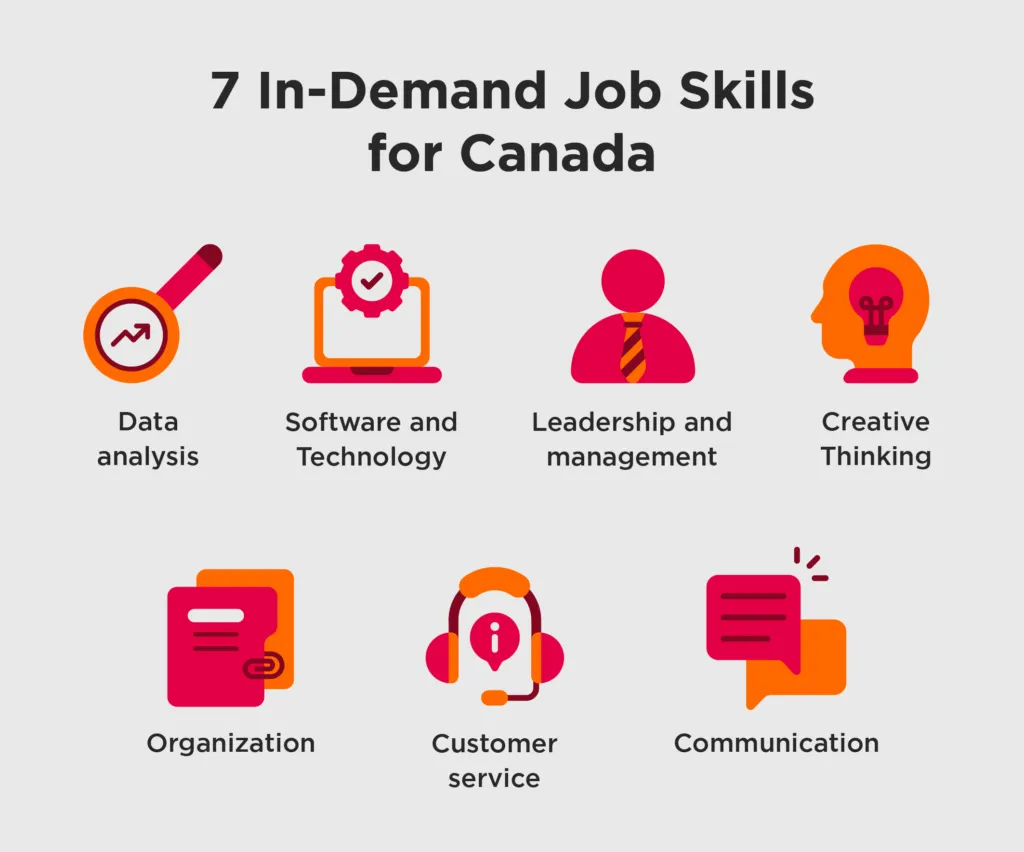
Across health care, education, business, and tech, most in-demand jobs in Canada share a common set of transferable skills. Therefore, employers in these fields look for people who can:
- Stay organized and manage time well
- Communicate clearly with clients, patients, and coworkers
- Use workplace software and learn new technology quickly
- Work with data and keep accurate records
- Solve problems and think creatively
- Lead others or work well on a team
- Provide excellent customer and client service
Want to strengthen these skills on your own schedule? Robertson’s online micro-courses, such as Professionalism, AI Fundamentals for Professionals and Active Listening to Lead, take as little as 10 hours. Browse all micro-courses.
Start Training for In-Demand Jobs in Canada
If you are ready to train for one of these in-demand jobs in Canada, explore Robertson’s programs or speak with a Student Advisor. In addition, you can learn about financial assistance options. Above all, we’ll support you before, during, and after your program: our Workforce team offers placement support for life, including help with resumes, job applications, and career changes.
Don’t quit your day job yet! Many of our diploma programs are offered online, so you can study while you work.